 Nations Unies
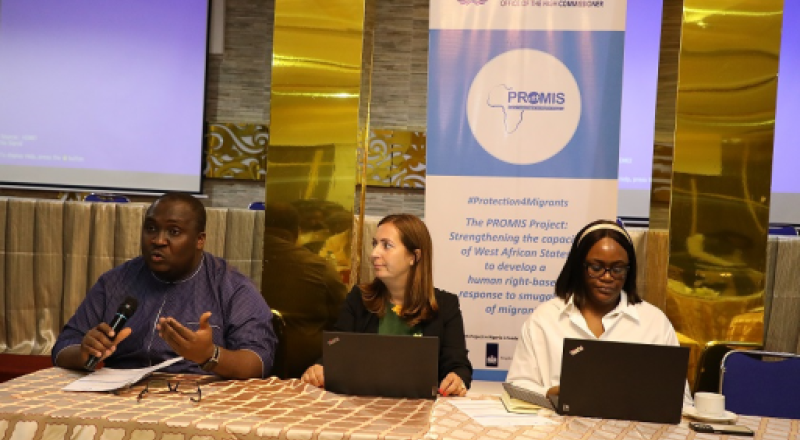
“Human Rights is at the heart of migration and must be respected in compliance with international best practices”
“Human Rights is at the heart of migration and must be respected in compliance with international best practices”, said the Executive-Secretary of the National Human Rights Commission (NHRC), Chief Tony Ojukwu, during his opening remarks at the two-day training on the protection of the rights of migrants. The training, organized by the Office of the United Nations High Commissioner for Human Rights (OHCHR) within the framework of the PROMIS project, aimed to enhance the capacity of the NHRC in addressing human rights issues related to international borders and its role in the protection of the rights of migrants at border areas during reception and interviewing of migrants. The participants included 28 NHRC staff (09 males and 19 females) from NHRC field offices in Abuja, Lagos, Kano, Sokoto, Edo, Ogun, Oyo, Cross River, Katsina, Borno and Taraba States in Nigeria.
The Executive Secretary of NHRC stated that, as human rights advocates and frontline defenders, staff of the National Human Rights stand on a strong legal and institutional footing to tackle this present and emerging styles of human rights violations. He pledged that the training received under the auspices of OHCHR PROMIS project will be extended to all NHRC’s state offices in due course as migration is all encompassing. “We will continue to work with our partners within and outside the government to strengthen policies, and practices that impact on human rights of migrants, victims of trafficking and smuggling of migrants.’’
Speaking at the training, Ms. Adwoa Kufuor-Owusu, the UN Senior Human Rights Advisor in Nigeria, said that migration related issues had affected countless lives of individuals and communities and that though migration could transform societies, economies and individual lives, its challenges could lead to violations of human rights of migrants, if not properly managed and safeguarded. According to her, “to manage and safeguard vulnerabilities that might arise in the context of migration, various legal and institutional frameworks were established both at international, regional, and national levels which states are obligated to uphold and fulfill and to which they are held accountable”.
During the training, the participants acknowledged the efforts of the government in creating laws and policies that protect migrants including the Nigerian Immigration Act and the National Action Plan on Human Trafficking in Nigeria (2022 – 2026); implementation of the Global Compact for Migration. They recommended that the role of NHRC in the protection of migrants’ rights at international border can be strengthen. This can be achieved through the regular monitoring missions to the border, increased sensitization and awareness of the public targeting specific groups on human rights and immigration processes, more capacity building for security personnel at border areas on adopting a human rights based approach to their work, more collaboration and partnership with other government agencies including UN agencies, and collection and harmonization of data through the creation of a human rights desk at the border. All these recommendations will ensure that Nigeria is taking steps to address the concerns raised by the Committee on the Protection of the Rights of All Migrant Workers and Members of Their Families in its concluding observations on Nigeria’s combined initial and second periodic reports in 2023.
On the last day of the training, a checklist on monitoring human rights situation at International Borders in Nigeria was developed. The checklist provides a set of questions that NHRC staff members will use to collect information on the human rights situation during monitoring missions at the international borders in their various locations. The checklist requires the NHRC monitors to collect information on migration data, information on human rights violations; conditions of holding centers; and constitutional guarantees. NHRC will develop Standard Minimum Guidelines on Conditions of Holding Centers in Nigeria, which will be attached to the checklist. The checklist will further be validated by critical stakeholders including the Nigerian Immigration Service (NIS), and the Nigeria Customs Service.