 Nations Unies
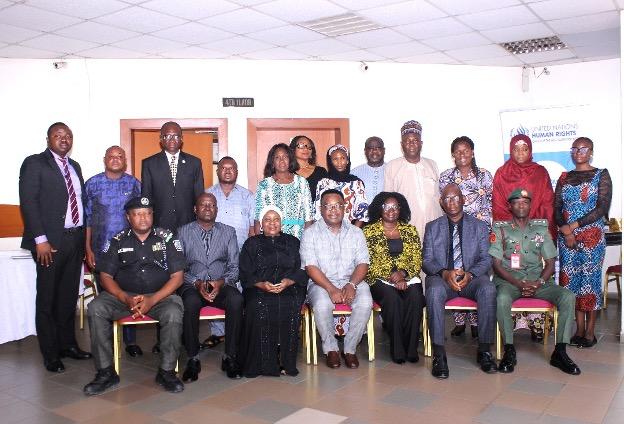
On 14 October 2025, OHCHR and NHRC convened a High-Level Briefing in Abuja to review the findings from recent human rights monitoring missions at Seme and Idiroko borders. The briefing validated key gaps and highlighted steps for border agencies to rehabilitate facilities, adopt standardized tools, strengthen staff welfare, deploy NAPTIP officers and interpreters, and expand community sensitization and inter-agency cooperation. A joint communiqué was adopted to guide follow-up and accountability.
On Tuesday, 14 October 2025, 22 border officials and partners (09 Women) participated in a High-Level Briefing on Findings from Border Monitoring Missions and Assessments covering Lagos (Seme) and Ogun (Idiroko) borders. The meeting, held in Abuja, brought together representatives from the Nigeria Immigration Service (NIS), Nigeria Customs Service (NCS), National Drug Law Enforcement Agency (NDLEA), Federal Ministry of Health/Port Health Services and Department of State Services (DSS), Federal Ministry of Justice, Nigeria Police Force, National Agency for the Prohibition of Trafficking in Persons (NAPTIP), the Nigerian Army, UNODC, NACTAL Nigeria, CSOnet MADE, gathered to engage in the discussion.
In his opening remarks, Dr. Tony Ojukwu, OFR SAN, Executive Secretary of NHRC, emphasized that migration is driven by insecurity, economic pressures, and climate change, but that “every migrant, irrespective of status, is entitled to the full protection of their human rights.” He reminded border officials that they are the “first face of Nigeria,” and their professionalism shapes how the country is perceived internationally.
Esther Michael Sawa, national representative of the PROMIS project at OHCHR, highlighted that protecting migrants’ dignity is a shared responsibility across agencies. “This is not about naming and shaming,” she said. “It is about identifying good practices, recognizing gaps, and finding solutions together.”
The briefing followed human rights monitoring missions conducted at Seme Border (25–26 June 2025) and Idiroko Border (29–30 September 2025) in partnership with IOM. These missions assessed entry/exit procedures, screening and referral practices, safeguards for vulnerable persons, detention conditions, access to services, and inter-agency coordination, with the goal of identifying protection needs and strengthening compliance with international standards.
Participants validated the findings and adopted a joint communiqué with concrete recommendations including rehabilitating holding centres, adopting standardized tools, improving staff welfare, deploying NAPTIP officers and interpreters, expanding community sensitization, ensuring inclusivity for persons with disabilities, enhancing inter-agency cooperation, and reducing checkpoints. The NHRC will further advocate for a human rights training manual and circulate both the communiqué and mission reports to agencies for follow-up.
The PROMIS project is a joint initiative between OHCHR and the United Nations Office on Drugs and Crime (UNODC) that aims to strengthen the capacities of West African states to develop a human rights-based response to Trafficking in Persons, Smuggling of Migrants, and related crimes, and to effectively respond to human rights violations related to irregular migration.