 Nations Unies
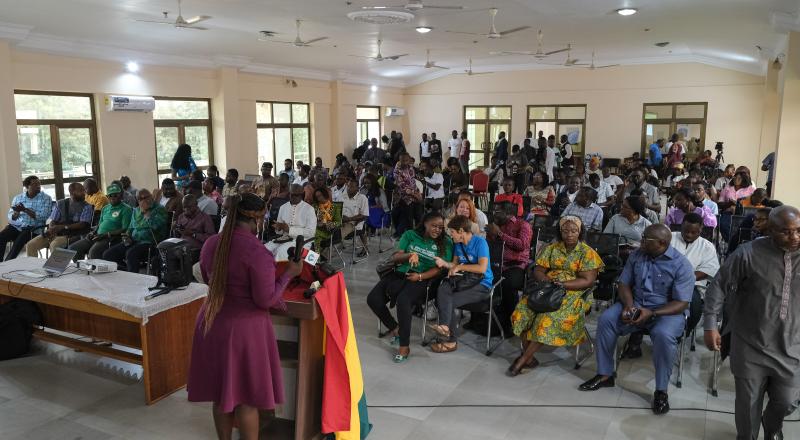
From 31 August to 3 September 2026, in Koforidua, Ghana's Parliamentary Committee on Human Rights held a capacity-building and monitoring activity aimed at strengthening parliamentarians' ability to promote and protect human rights. The goal: to help MPs translate recommendations from international human rights mechanisms into concrete action within their legislative, budgetary and oversight functions.
The activity brought together 26 participants (21 men, 5 women), including MPs, technical staff of Parliament, and representatives from the Inter-Parliamentary Union (IPU), the Commission on Human Rights and Administrative Justice (CHRAJ), the Ministry of Gender, and the Ministry of Labour.
The training equipped parliamentarians with practical knowledge, tools and strategies to support the implementation of recommendations arising from Ghana's fourth-cycle Universal Periodic Review (UPR), the Committee on the Protection of the Rights of All Migrant Workers and Members of Their Families, and the Global Compact for Safe, Orderly and Regular Migration. Participants drew in particular on the Universal Human Rights Index and the OHCHR-IPU Human Rights Handbook for Parliamentarians.
Following the training, Ghana's Parliamentary Committee on Human Rights made several commitments. It pledged to support the adoption of revised legislation governing the national human rights institution during the next parliamentary session, in October 2027. It also committed to engaging relevant stakeholders to strengthen the National Mechanism for Implementation, Reporting and Follow-up, in order to ensure more effective follow-up on recommendations from the UPR and other international human rights mechanisms.
Parliamentarians also conducted monitoring visits to two municipalities, Suhum and Abuakwa South, and two communities, Jato and Kwesi-Kunfor, in Ghana's Eastern Region. These visits provided firsthand evidence of human rights issues linked to illegal small-scale mining, known as "Galamsey," particularly its impact on children, including child labour, child marriage, and gaps in social protection. Local and traditional authorities called for stronger parliamentary action to curb the practice.
The activity was led by Ghana's Parliamentary Committee on Human Rights, with technical and financial support from the OHCHR Regional Office for West Africa, in collaboration with the country's national human rights institution. Additional support came from the Inter-Parliamentary Union, UNICEF Ghana, and the African Centre for Parliamentary Affairs. OHCHR facilitated several sessions on Parliament's role in implementing recommendations from international human rights mechanisms, as well as on the international legal framework for the protection of migrant workers and their families.