 Nations Unies
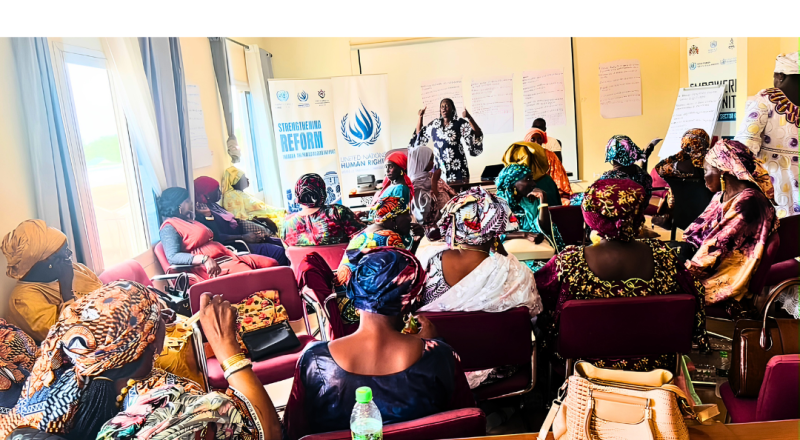
When a teenager in Jarra Soma falls into drug abuse, when a woman needs somewhere safe to turn, or when a family stops trusting the police to protect them, it is often a Bajenu Gox who is called first. These respected women community leaders are, in many ways, the Gambia's first responders - and often the first line of defence for people's rights - long before any uniformed officer arrives.
Turning that trust into a stronger, more accountable security sector was the aim of a two-day residential training that brought 30 of them together in Jarra Soma, Lower River Region, from 15 to 16 September 2026. The training was organized by OHCHR together with the Office of National Security (ONS), the National Human Rights Commission (NHRC), and the CSO Coalition on Security Sector Reform, and grounded throughout in a human rights-based approach - one that treats communities not as passive beneficiaries but as rights holders, and security institutions as duty bearers accountable to them. Building public trust in security institutions, the organizers argued, starts with giving communities a genuine role in shaping the reforms meant to serve them.
The participants travelled from six Local Government Areas across the country. As trusted women leaders and community mobilizers, they came away with practical knowledge and skills on Security Sector Reform (SSR), democratic governance, civilian oversight, community policing, human rights, and gender-responsive security governance - the tools they need to keep playing their role as a bridge between communities and the institutions meant to protect - and be accountable to - them.
Rather than lecturing at participants, the training was built around interactive presentations, experience-sharing sessions, group work, and hands-on exercises, all designed to deepen the Bajenu Gox's understanding of SSR and of their own role in promoting security governance that is inclusive, accountable, non-discriminatory, and centered on people. The results spoke for themselves: assessments taken before and after the training showed significant learning gains, with participants demonstrating a strong grasp of SSR concepts by the end of the two days.
The women did not just listen - they spoke. Throughout the discussions, the Bajenu Gox described the realities facing their communities: drug abuse among young people, gender-based violence, threats to children's safety, cross-border tensions, unemployment, and a persistent lack of trust in justice institutions. These exchanges did more than inform the training - they grounded SSR in the everyday problems it is meant to help solve, and reinforced why the meaningful participation of rights holders in security governance matters in the first place.
Many participants shared stories of having already stepped in themselves: mediating community disputes, responding to domestic violence cases, and protecting children at risk. These were not hypothetical scenarios discussed in the abstract - they were lived experience, and a reminder that Bajenu Gox are often the first, and sometimes the only, line of defence for their communities' rights, long before any formal institution gets involved.
The Bajenu Gox left Jarra Soma better equipped not only to raise awareness of SSR in their communities, but to help build the kind of constructive engagement between communities and security institutions that reform depends on. As The Gambia advances its own reform agenda, this training was a reminder that lasting change rarely starts in a ministry - it starts with the leaders communities already trust. Investing in them is not a side note to security sector reform; it is how a security sector becomes genuinely accountable, transparent, and responsive to the rights and needs of everyone it serves.