 Nations Unies
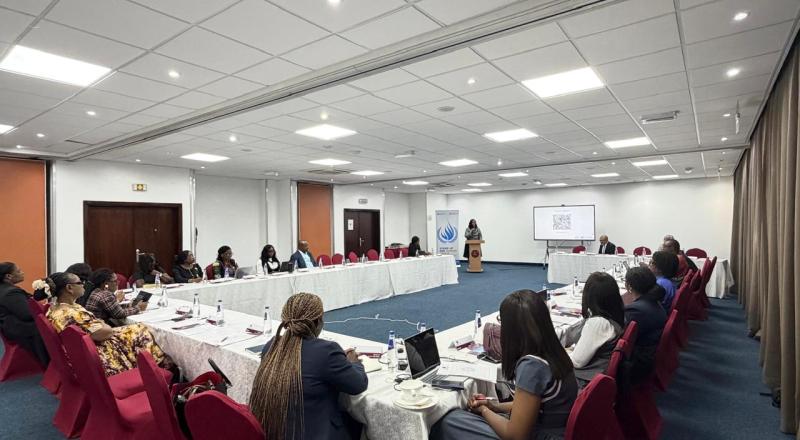
Ghana’s National Mechanism for Implementation, Reporting and Follow-up (NMIRF) advanced preparations for the country’s overdue reports to two United Nations human rights treaty bodies during a workshop held in Accra on 17 and 18 November 2026. The workshop also laid the groundwork for preparations for the fifth cycle of the Universal Periodic Review (UPR), with a focus on strengthening national coordination and assessing progress in implementing human rights recommendations.
The workshop aimed to strengthen the NMIRF’s capacity to monitor, coordinate and follow up on national efforts to fulfil Ghana’s international human rights obligations. Discussions emphasized the importance of linking reporting with implementation, ensuring that engagement with human rights mechanisms supports progress in the protection and realization of human rights.
Supported by the Office of the United Nations High Commissioner for Human Rights (OHCHR) Regional Office for West Africa, the United Nations Resident Coordinator’s Office, the Office of the Attorney General and other partners, the workshop brought together 43 participants (34 women and nine men). Participants represented government institutions, the Commission on Human Rights and Administrative Justice, UNESCO, UNDP and other organizations.
Speaking at the opening, the United Nations Resident Coordinator in Ghana, Mr. Zia Choudry, emphasized that the effectiveness of Ghana’s human rights commitments depends on the implementation of recommendations issued by human rights mechanisms. He highlighted the NMIRF’s central role in coordinating national action and ensuring sustained follow-up.
Ghana’s Solicitor General, Mrs. Helen Ziwu, underscored the need for systematic follow-up to assess progress and support effective implementation ahead of the fifth UPR cycle. She also called on participants to agree on a clear way forward for completing Ghana’s outstanding reports to African Union and United Nations human rights mechanisms.
Through technical discussions and drafting sessions, participants developed initial reporting matrices for Ghana’s reports to the Human Rights Committee under the International Covenant on Civil and Political Rights and to the Committee on Economic, Social and Cultural Rights under the International Covenant on Economic, Social and Cultural Rights. These matrices will help organize information on measures taken to implement the two Covenants and support the preparation of the outstanding reports.
Participants also consolidated recommendations to inform the finalization of the NMIRF’s standard operating procedures and identified a methodology for assessing the implementation of human rights recommendations ahead of the next UPR cycle. These efforts advanced preparations for reporting while strengthening the processes needed to track implementation across national institutions.
OHCHR led the workshop’s technical and drafting work, providing guidance on international human rights mechanisms, treaty body reporting, follow-up to recommendations and good practices for effective national mechanisms. In collaboration with the United Nations Resident Coordinator’s Office, UNDP and UNESCO, OHCHR also facilitated sessions to compile information on Ghana’s implementation of the two Covenants and advance the corresponding reporting matrices.
The workshop marked a step towards more coordinated human rights reporting and follow-up in Ghana. Completing the outstanding reports, finalizing the NMIRF’s standard operating procedures and applying the identified assessment methodology will be important to sustaining this progress and translating Ghana’s human rights commitments into effective national action.